Inaccurate and Seemingly Not Improving: Disney Channel Representations of Class
Disney Channel approaches class stiltedly, interweaving a less obvious but still omnipresent depiction of the American Dream, creating clear divides between racial and economic classes, but ignoring depictions/ groups that they don’t value, and glamorizing those that they do, consequently creating a similar value system for their audiences.
One of the prevailing, yet most unnoticed, problems with many TV shows across networks is the creation of an unrealistically wealthy environment. Disney Channel is not exempt from this. They positively showcase the hardworking middle class, while depicting them as far wealthier than they are/ should be considering their backstory: a letdown for children when they grow up to realize how difficult wealth accumulation can actually be, as well a false marker of ultimate wealth success that can stunt those who would go farther.
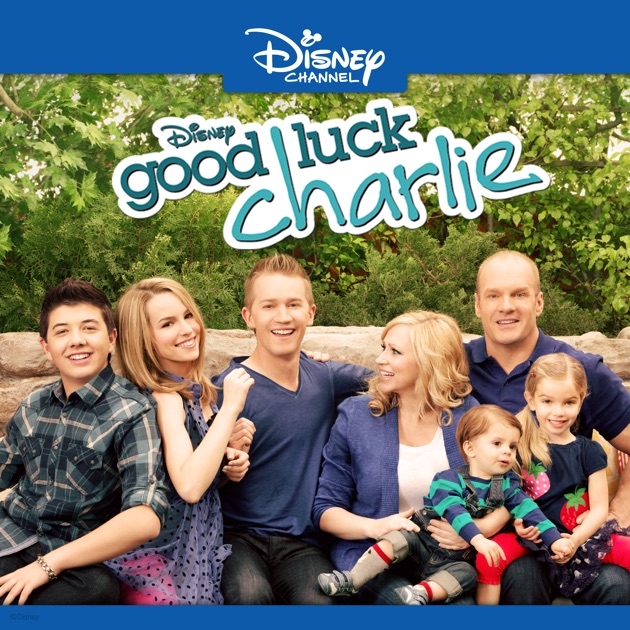
From shows such as Good Luck Charlie to the more recent, Stuck in The Middle, large families are depicted as somehow managing to have financial struggles and/or ordinary middle class jobs, while still having large suburban homes, and being able to expand the home or make random exorbitant purchases as they align with whatever hijinks the characters get up to. In particular, with shows such as Stuck in the Middle, pre-teen/ young teen children are depicted as random entrepreneurs with a myriad of highly profitable businesses, something which completely ignores basic economics and child labor laws.
 |
| Via iTunes |
 |
| Via iTunes |
Other shows try to depict a difference between wealth classes and the consequent differences in personality, integrity, sense of family, etc. Some characters, such as London Tipton (a blatant caricature of Paris Hilton) from The Suite Life of Zack & Cody, and The Suite Life on Deck, are used to illustrate problems with too much wealth and privilege.
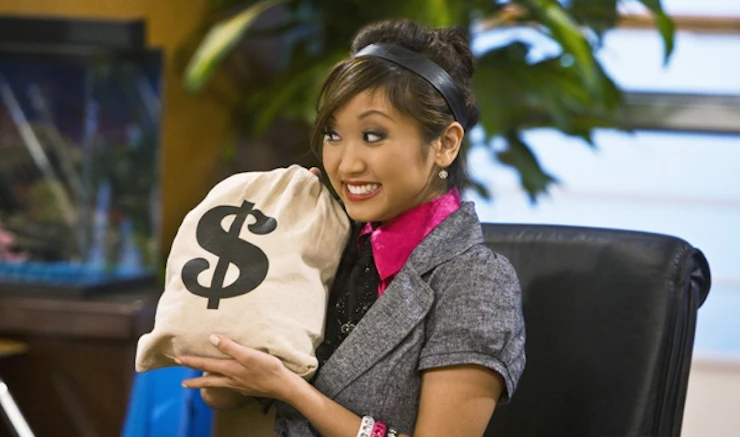 |
| Image of the character London Tipton via Bustle |
London can often be seen as a superficial snob who disrespects lower-class people, she does make exceptions for those who she really cares about and has been shown to be somewhat loyal to her friends. (4)
She is extremely wealthy, but lacks true family bonds, struggles to empathize and make lasting relationships, and is generally clueless about the world despite having access to private education. In stark contrast, virtually every other character juxtaposed to her is middle class, yet have stronger relationships, generally more intelligence and live happier, fuller lives. London only begins to form any real meaningful bonds when she socializes with more middle-class individuals.
In shows such as these, Disney attempts to not only glamorize the middle class but diminish the upper wealth classes. In this way, it appears they are trying to tear down the American Dream, by encouraging people to remain in the middle class and be content with their lives there. However, their consistent inability to depict the middle class as anything but uncharacteristically wealthy drives the poorer class to strive for these depictions, and the wealthy -under the mistaken assumption that they are not as wealthy as they actually are- to strive for more than they already have. The success levels of these efforts aren’t necessarily high, but the views on class they create remain.
Disney Channel also showcases a stilted depiction of race when it comes to class. “Most Disney Channel programs both foreground and normalize whiteness and middle- or upper-class socioeconomic status.” (5) This is most notable with characters such as Zuri from the more recent show Jessie and its consequent spinoff Bunk’d.
A middle class white family adopted Zuri when she was young. Even though a middle class white family raised her, she still takes on stereotypical black roles. Zuri is constantly being sassy and seems to have a problem respecting adults. In addition to this Zuri uses stereotypical black catch phrases such as, ‘Oh no you didn’t,” and “Mmmmhmm”. […] Why would Zuri be taking on hegemonic black stereotypes when she was raised in a middle class white family? (6)
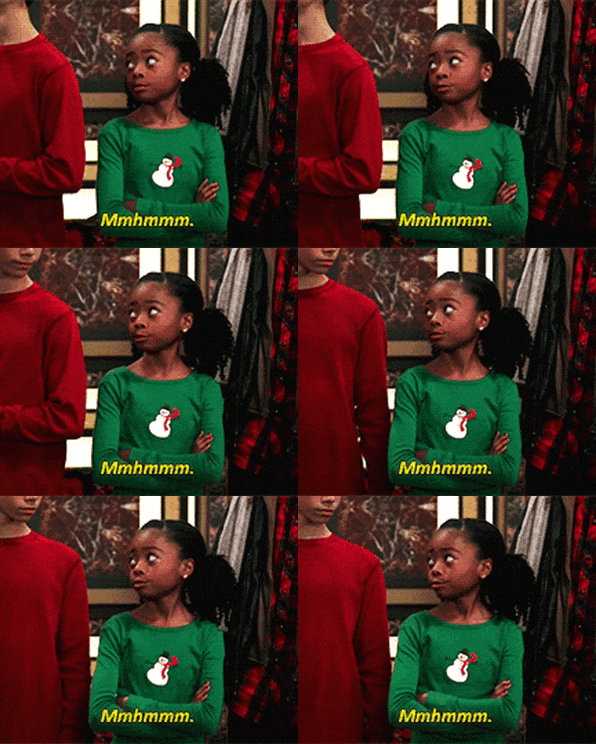 |
| Gif via Giphy |
Even when attempting to be racially diverse, Disney seems to struggle to conceptualize the realities of intersectionality, of how race and wealth actually overlap. Often they don’t seem to care. And while one could argue that they are perhaps attempting to shelter their young audience from seeing less desirable wealth situations for example, (despite several of their audience possibly being in them), it does not explain their struggles with unproblematic depictions of such complex, interconnected identities.
In this case, this is one of the rare situations in which Disney is not improving, nor do they seem to be attempting to (there is a rare depiction in The Descendants franchise of a sort of ‘poverty’, but the way they vilify it is problematic). They do not necessarily need to showcase extreme suffering, but even a less damaging portrayal of real people might be more helpful in the long run than a stilted myth.
Works Cited
1. Good Luck Charlie iTunes Cover Art
2. Stuck in the Middle iTunes Cover Art
3. Image of London Tipton
4.Disney Channel Wiki: London Tipton
5.Blue, Morgan Genevieve, Girlhood on Disney Channel: Branding, Celebrity, and Femininity, Routledge 2017, 63. Google Books
6. Beeninga, Allie, Is Disney Family Friendly? Or just racist?, 2015. Student Blog Post
7. Gif of Zuri Ross
Comments
Post a Comment